
(In progress)

Idea projektu
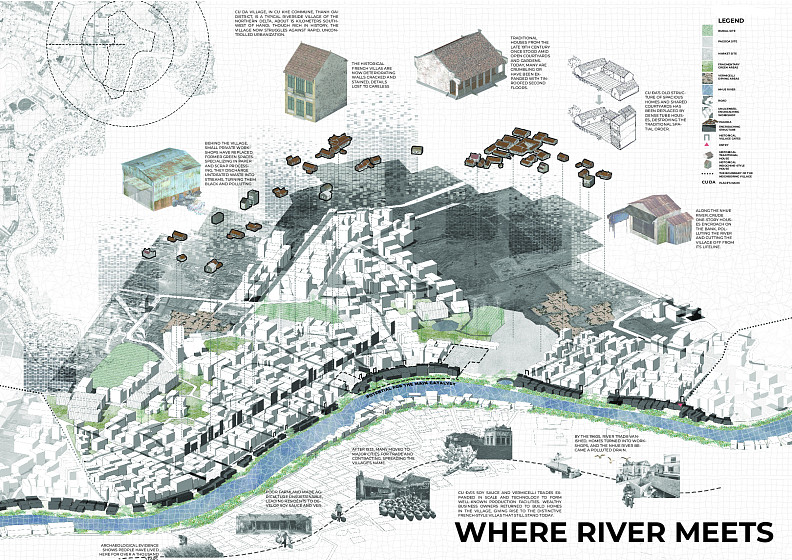
Cu Đa Village, located in Cu Khe Commune, Thanh Oai District, approximately 15 kilometers southwest of Hanoi, is a typical riverside settlement of Vietnam’s Northern Delta. With a long-standing cultural and architectural heritage, the village has historically been characterized by spacious traditional houses, shared courtyards, gardens, and a close relationship with the Nhue River. Today, however, Cu Đa faces severe challenges resulting from rapid and uncontrolled urbanization.
In recent decades, former green spaces behind the village have been replaced by small private workshops, primarily engaged in paper and scrap processing. These facilities discharge untreated waste directly into local streams, turning them black and heavily polluted, thereby degrading both the natural environment and the living conditions of residents. Alongside environmental decline, Cu Đa’s architectural heritage is steadily deteriorating. Historic French villas are falling into disrepair, with cracked and stained walls and the loss of original architectural details due to neglect. Traditional houses dating back to the late nineteenth century—once set within open courtyards and gardens—are now crumbling or have been irreversibly altered through the addition of tin-roofed upper floors.
The village’s original spatial structure, defined by generous plots and communal courtyards, has largely been replaced by dense tube houses that disrupt the traditional urban fabric and social organization. Along the banks of the Nhue River, informal one-story dwellings encroach upon the water’s edge, further polluting the river and severing the village’s historical and functional connection to its primary lifeline.
This project seeks to address these intertwined environmental, spatial, and cultural challenges. Its primary objective is to restore the ecological health of the village, particularly its waterways and riverfront, while preserving and revitalizing Cu Đa’s architectural and spatial heritage. By proposing sustainable strategies for environmental remediation, heritage conservation, and controlled development, the project aims to reestablish a balanced relationship between living, production, and nature, ensuring that Cu Đa Village can evolve without losing its historical identity and cultural value.
Popis projektu
The scope is organized into two interrelated phases:
Phase 1: Short-Term Intervention (2–6 Years)
The short-term phase establishes the foundational framework for regeneration through urgent intervention, value protection, spatial control, and reconnection. Its primary aim is to stabilize the village, prevent further degradation, and define clear boundaries and rules for transformation with key objectives:
* Protect existing historical, cultural, and spatial values.
* Restore connections within the village and between the village and the river.
* Control construction and land use to prevent uncontrolled expansion.
* Prepare a clear spatial structure to guide long-term transformation.
New construction is strictly limited to three stories, must follow minimalist forms, light colors, and traditional or local materials, and prohibits post-construction extensions. This phase prioritizes the removal of river encroachments, obstructive house additions, and polluting workshops, followed by water treatment and the restoration of panoramic views that narrate the village’s historical and cultural identity. Development begins at the village core and extends along the river through accessible paths and ramps, where demolished houses are transformed into green spaces to reestablish the traditional herringbone structure connecting the settlement to the Nhuệ River, while architecture acts as a catalyst for daily cultural, social, and economic activities.
Phase 2: Long-Term Structural and Ecological Sustainability (100+ Years)
The second, long-term phase secures a structural framework capable of lasting over a century, within which spaces adapt to natural cycles and social change, including residential areas, traditional houses for tourism, ponds, walkways, playgrounds, cultural exchange spaces, agriculture, and sports facilities. This phase develops a connected green network that functions as a soft protective barrier, restores the village–river relationship, and integrates former factory land into ecological buffers, while promoting self-sustaining environmental systems and experiential cultural tourism to strengthen the economy and reinforce the enduring relationship between people, heritage, and nature.
Technické informace
The project is constructed using a modular steel frame system combined with reinforced cement components and glass partitions. This construction approach ensures structural stability, durability, and flexibility while remaining accessible to local building practices. The use of steel framing allows for ease of assembly, adaptation, and repair, while cement provides long-term strength and resistance to weathering. Glass partitions are incorporated to enhance natural lighting, visual permeability, and spatial continuity without compromising structural integrity. Together, these materials and techniques enable local residents to participate directly in construction, maintenance, and future modification, supporting affordability, knowledge transfer, and long-term sustainability of the built environment.
Dokumentace

Copyright © 2026 INSPIRELI | All rights reserved. Use of this website signifies your agreement to the Terms of Use, Privacy Policy, and use of cookies.
