Breath of the Earth


 Professor Siamak Panahi
Project idea
House Rising from Its Own Soil
Yazd, a deeply rooted city in the heart of the desert, stands as a testament to humanity’s intelligent adaptation to nature; a place where traditional architecture—through windcatchers, domes, and central courtyards—has offered precise responses to a hot and arid climate. Nevertheless, the expansion of contemporary construction has weakened the connection between present-day living and this valuable architectural heritage.
The present project is an attempt to reread this legacy and to continue the experience of dwelling within a native and sustainable context. In this design, traditional elements are not replicated formally, but rather reinterpreted conceptually, with a focus on climatic responsiveness, the relationship between private and collective spaces, and the use of natural energies.
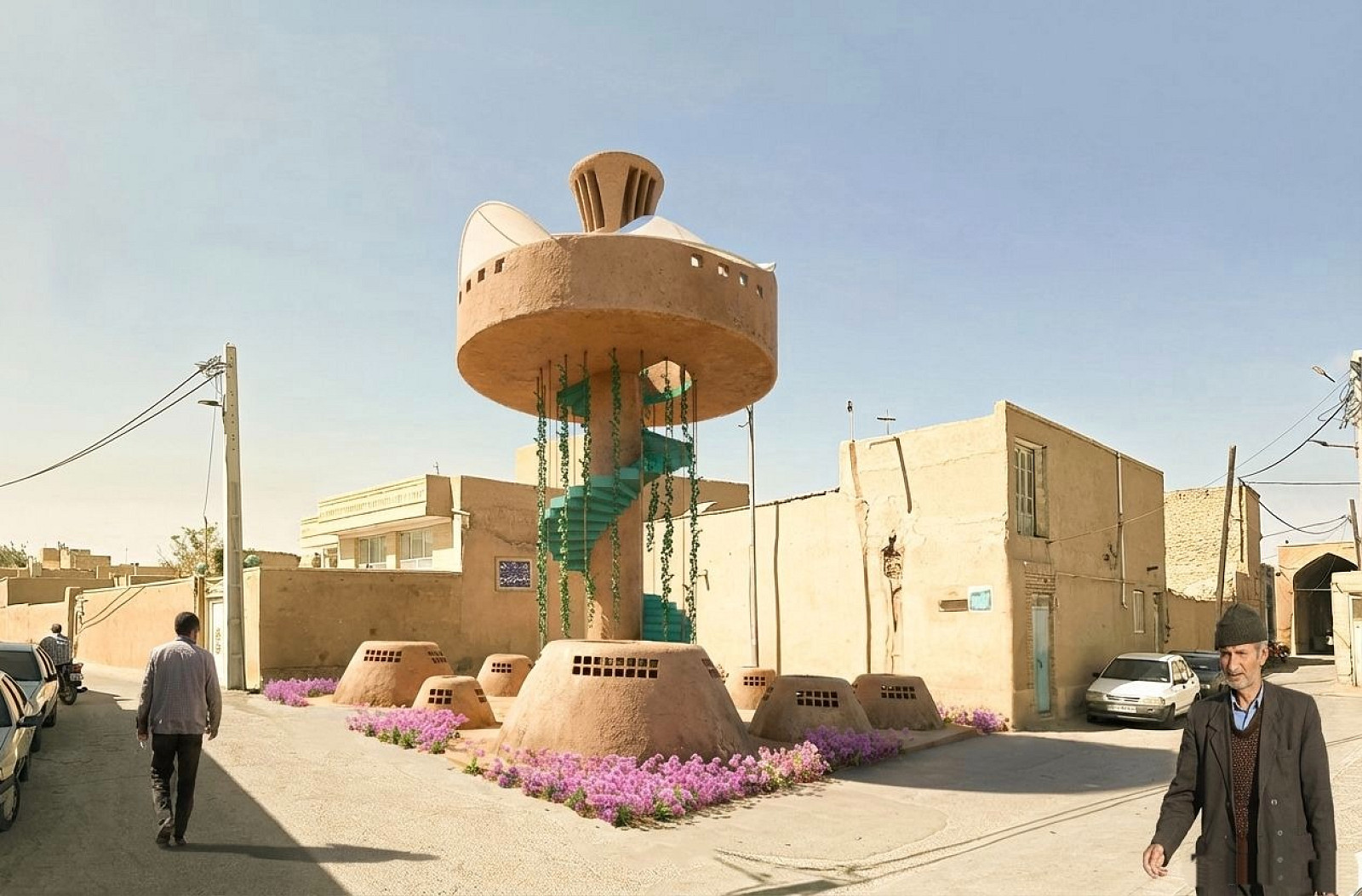
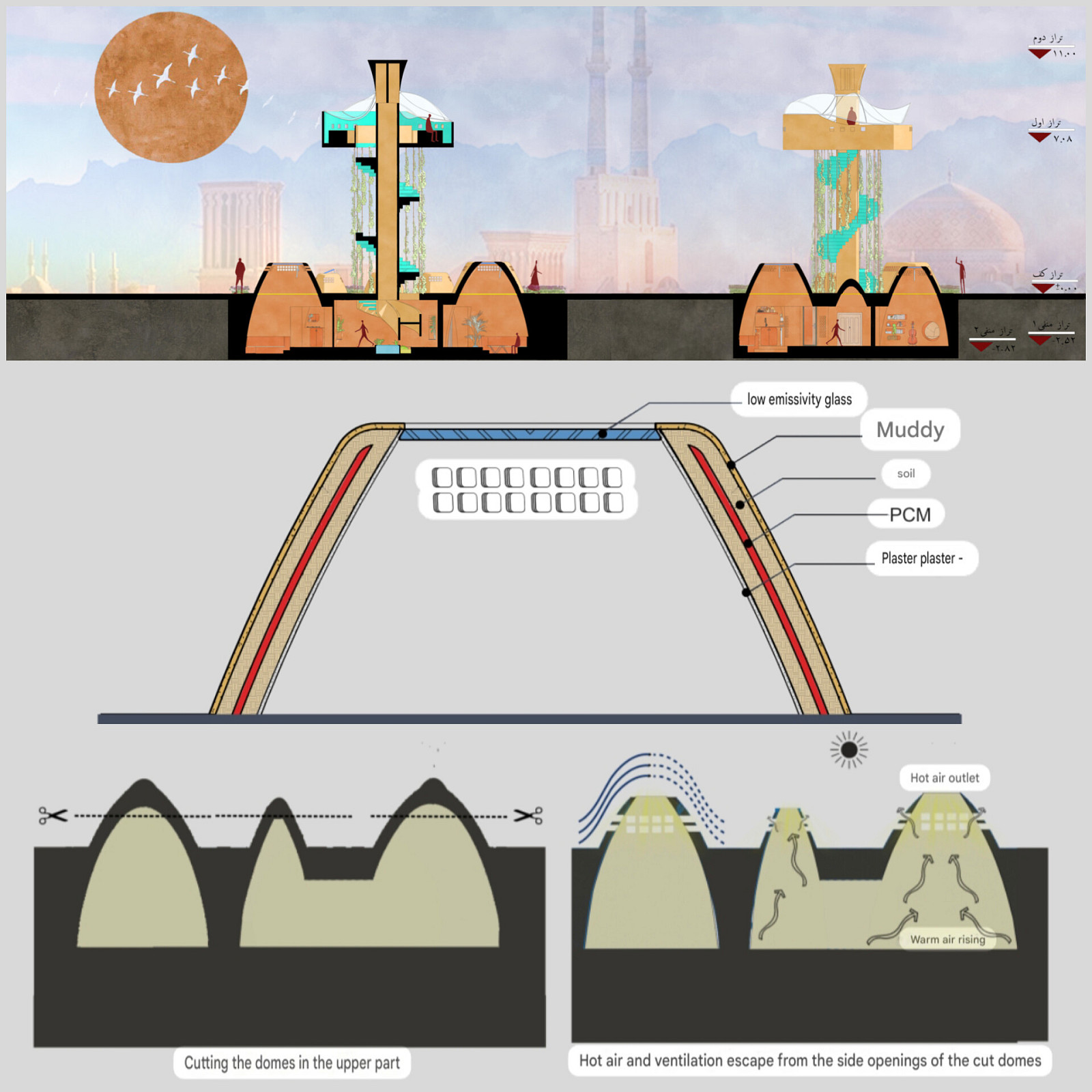
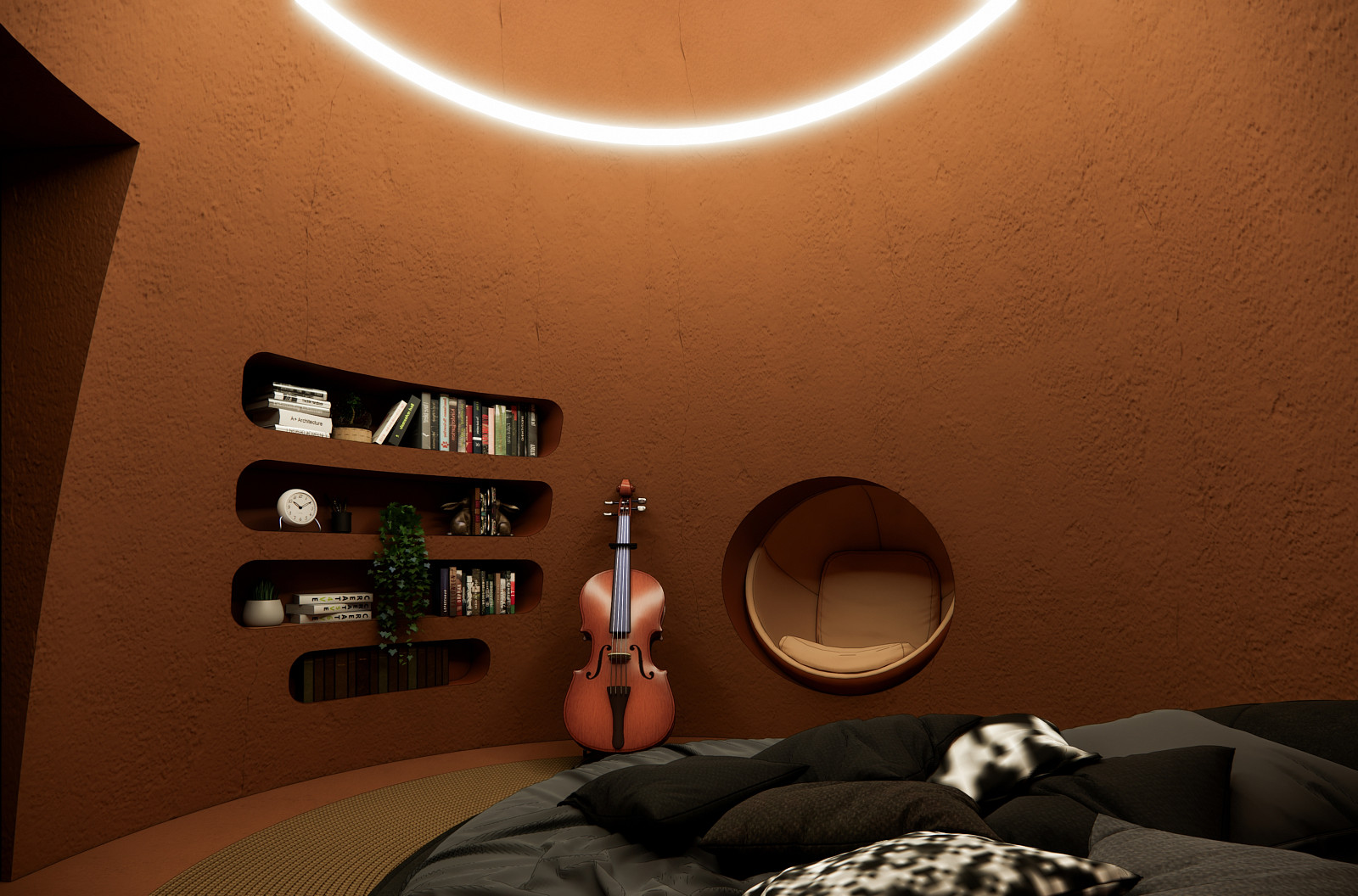
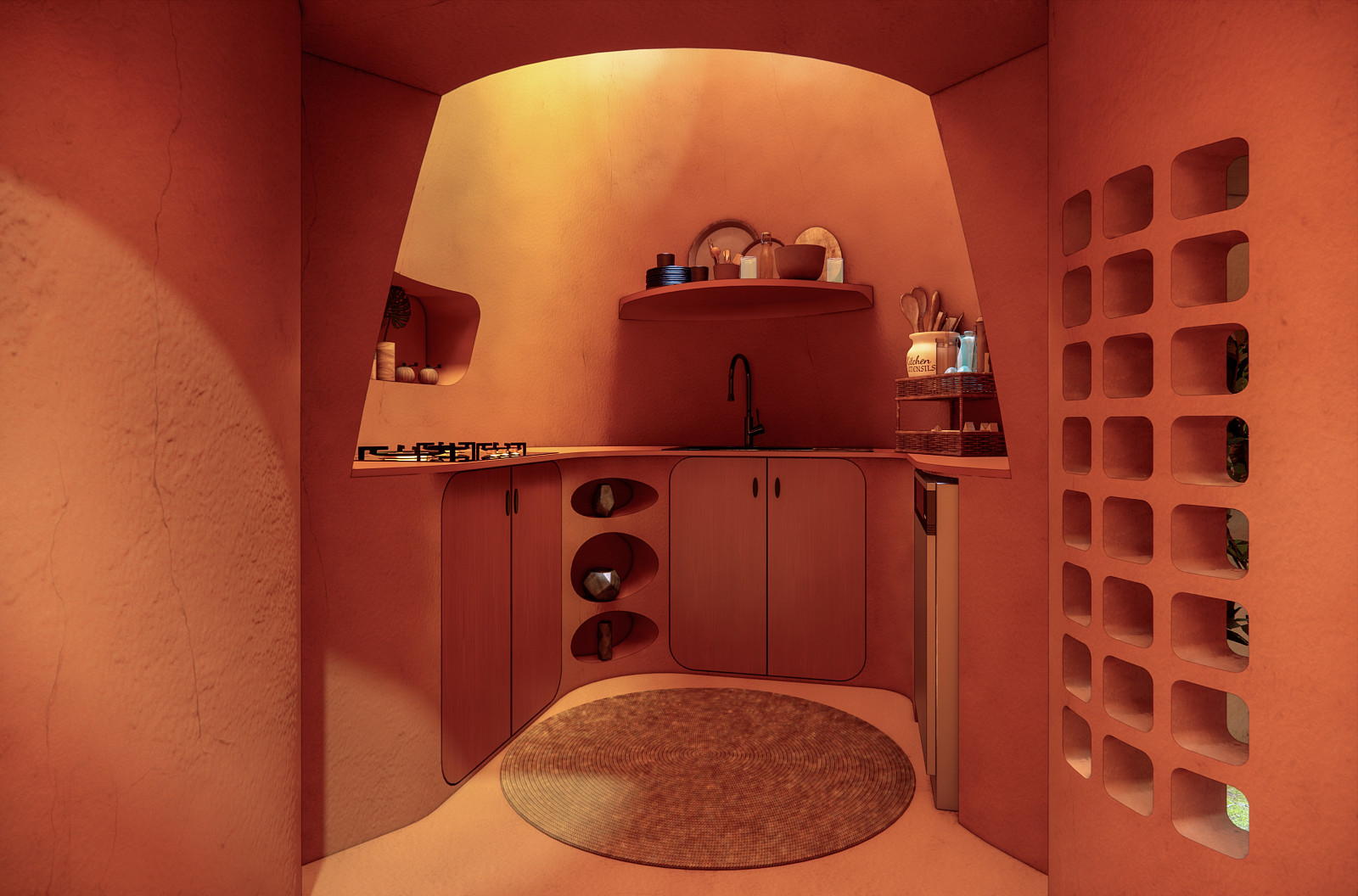
The house is built from the very soil excavated from its site—soil that comes back to life in the form of domes and walls. These domes act like the lungs of the earth, expelling hot air, while PCM layers integrated into the roof store daytime heat and gradually release it during the cool of the night, establishing a sustainable thermal balance between day and night.
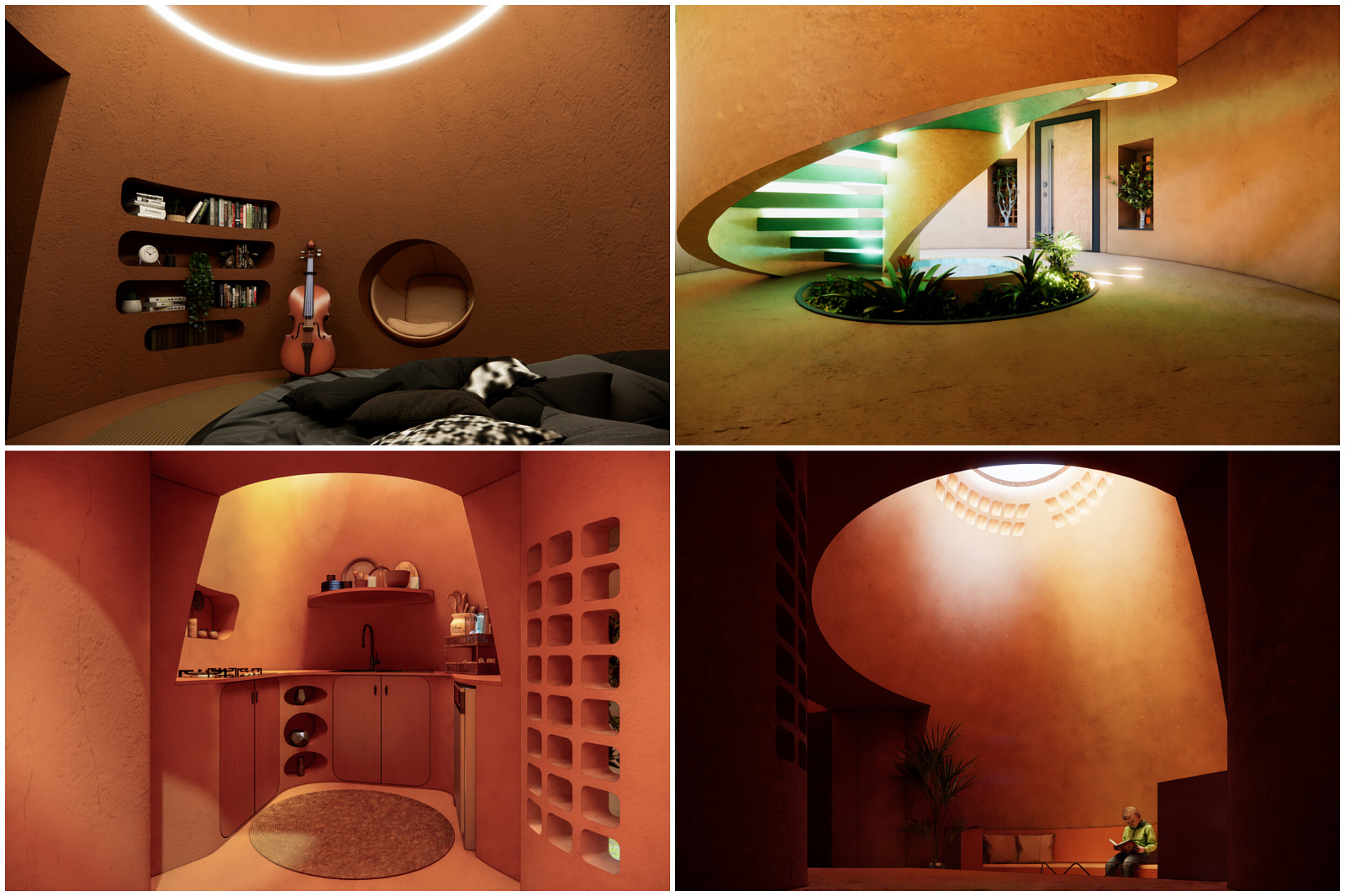
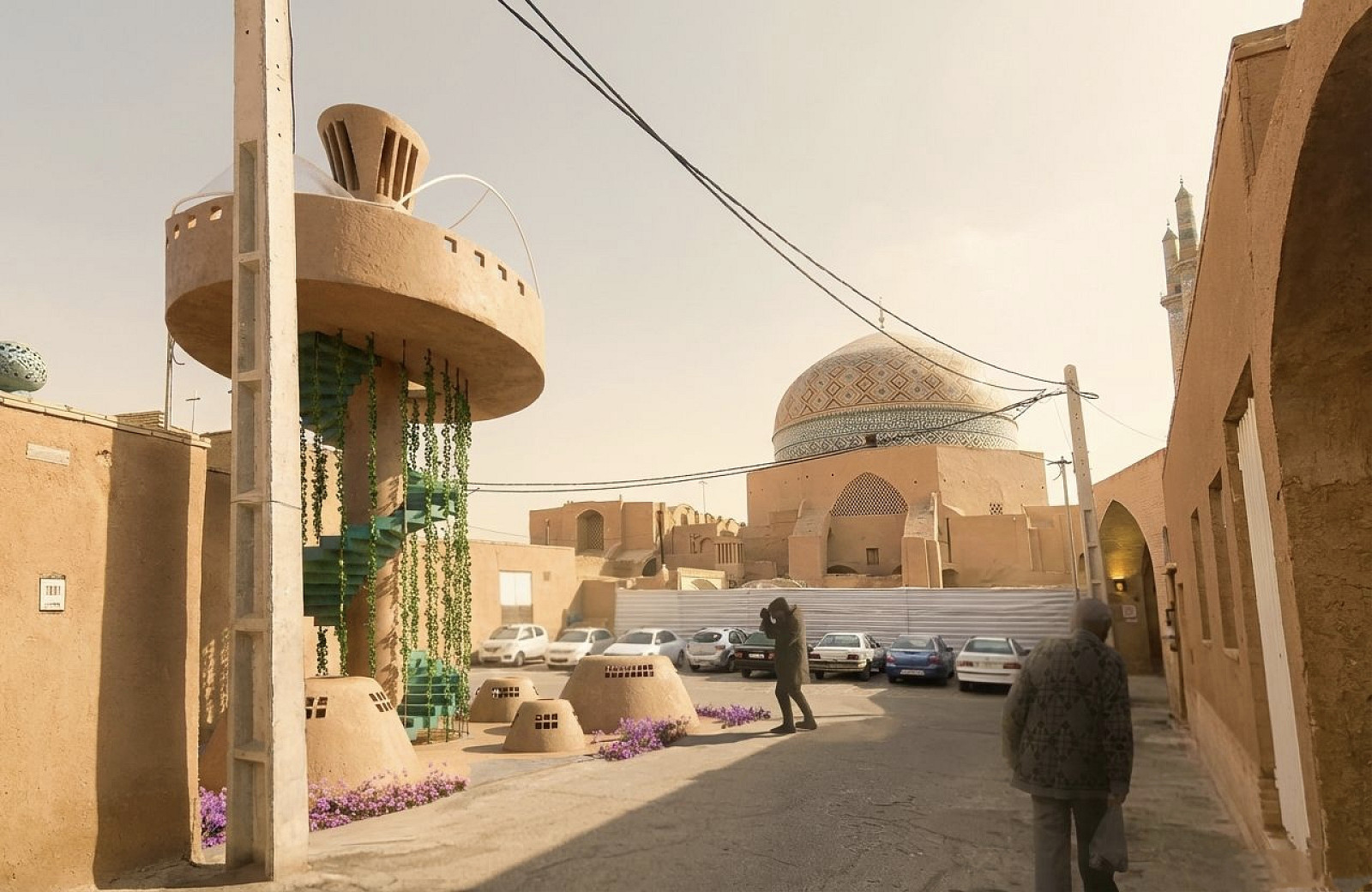
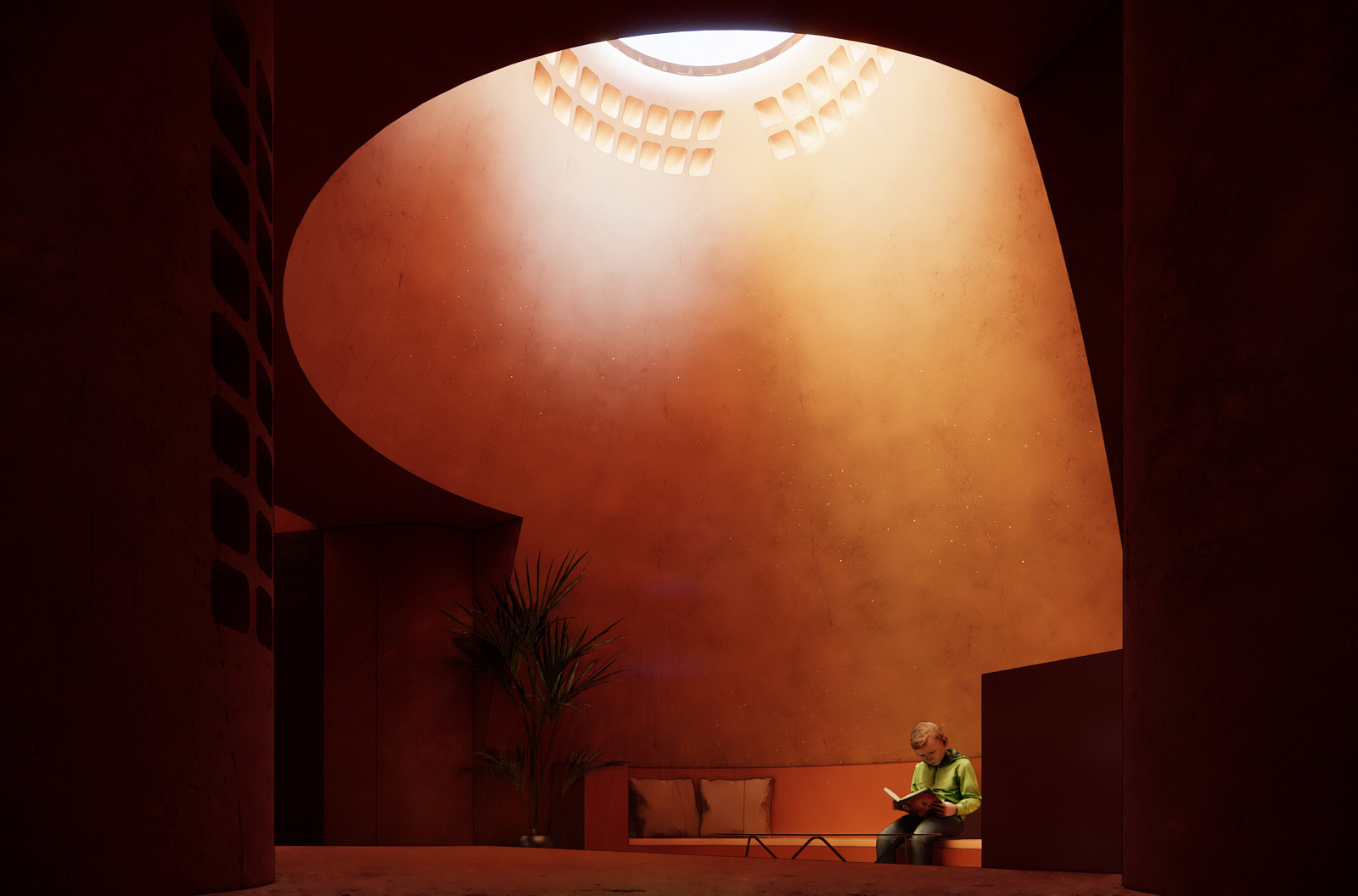
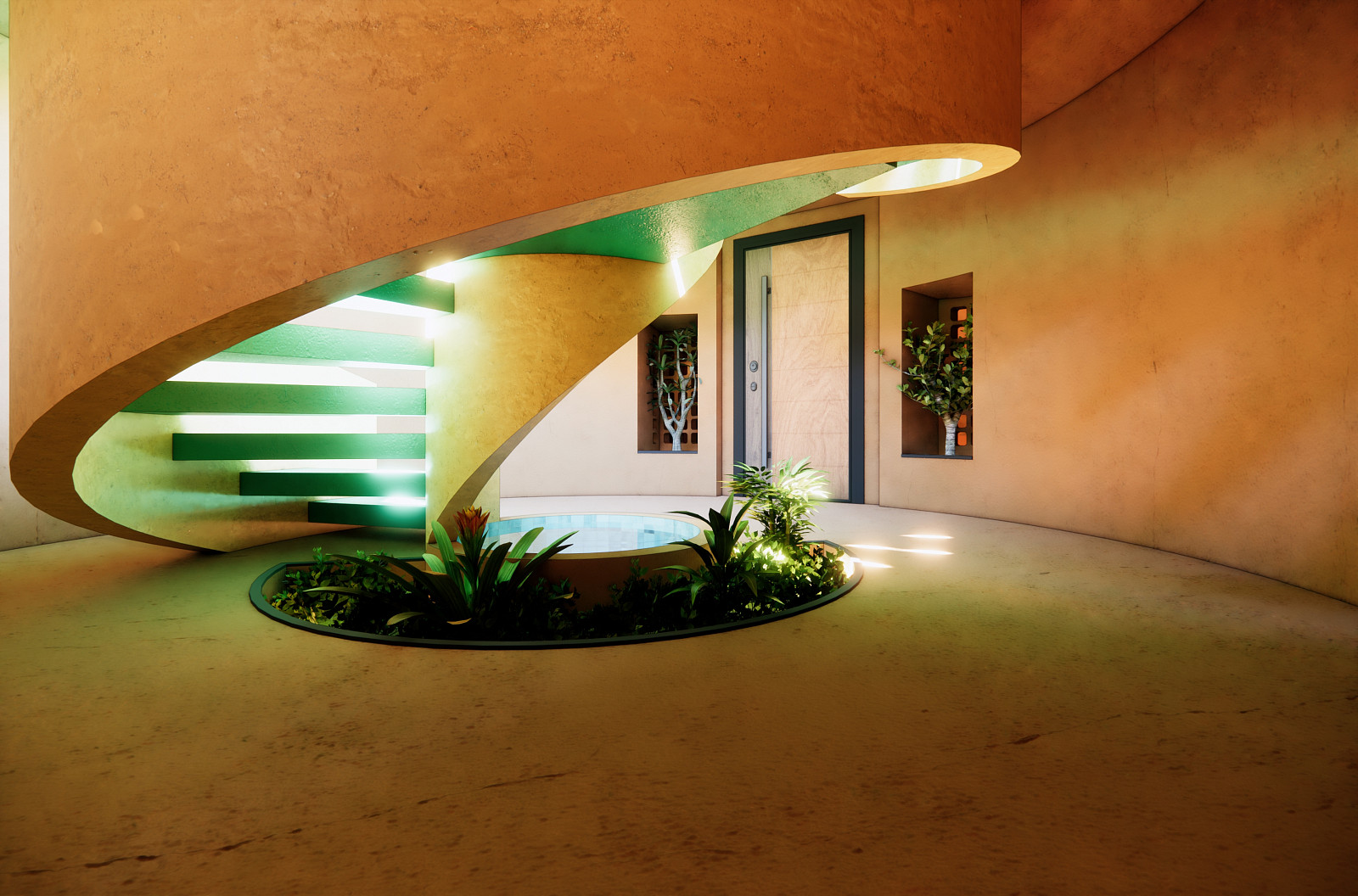
Descending into the underground levels takes advantage of the earth’s internal energy and its natural thermal stability, reducing the need for mechanical heating and cooling. At the heart of the building stands a tower—a contemporary hybrid of minaret and windcatcher—an element that both channels airflow and organizes human movement from interior to exterior. Its spiral staircase embodies a symbolic journey from stillness in the depth of the soil to dynamism at height; from the coolness of the earth to the warmth of social life.
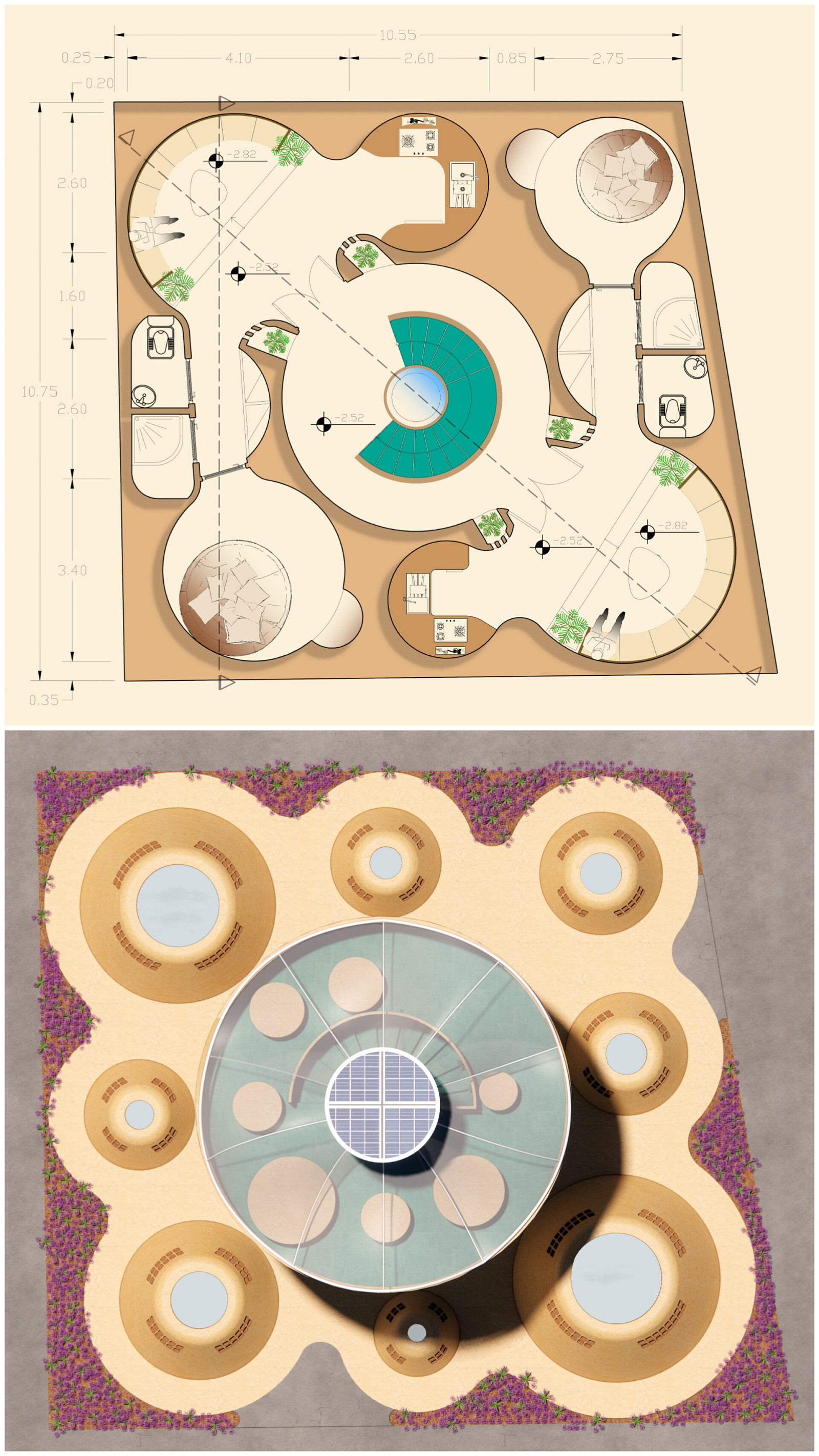
The house is designed for two families: two independent units that, while functionally autonomous, coexist in a soft and symbiotic relationship. The spatial organization of the project is shaped around the concept of “shared breathing.” Each family maintains its own private realm, while shared spaces such as the courtyard and the mahtabi provide a setting for encounter and dialogue. This structure reflects the culture of coexistence in Yazd, where neighborhood is not defined by boundaries, but by connection.
Adjacent to the windcatcher, a circular space is formed around its axis—a place for gathering, conversation, and observing the sky. This space is a contemporary reinterpretation of the Yazdi mahtabi; a place where families once gathered in the cool night breeze. Today, this renewed mahtabi emerges as a ring encircling the windcatcher—a place where wind, light, and sound flow among people, and conversation becomes the essence of space.
Ultimately, this project is founded on the relationship between human beings, nature, and community; where architecture is not an isolated object, but a living process that breathes within a cycle between earth, material, and humanity. The house here is not a structure standing against the city, but a part of it—an embodiment of the spirit of Yazd in the breath of the soil.
Project description
House Rising from Its Own Soil
Yazd, a deeply rooted city in the heart of the desert, stands as a testament to humanity’s intelligent adaptation to nature; a place where traditional architecture—through windcatchers, domes, and central courtyards—has offered precise responses to a hot and arid climate. Nevertheless, the expansion of contemporary construction has weakened the connection between present-day living and this valuable architectural heritage.
The present project is an attempt to reread this legacy and to continue the experience of dwelling within a native and sustainable context. In this design, traditional elements are not replicated formally, but rather reinterpreted conceptually, with a focus on climatic responsiveness, the relationship between private and collective spaces, and the use of natural energies.
The house is built from the very soil excavated from its site—soil that comes back to life in the form of domes and walls. These domes act like the lungs of the earth, expelling hot air, while PCM layers integrated into the roof store daytime heat and gradually release it during the cool of the night, establishing a sustainable thermal balance between day and night.
Descending into the underground levels takes advantage of the earth’s internal energy and its natural thermal stability, reducing the need for mechanical heating and cooling. At the heart of the building stands a tower—a contemporary hybrid of minaret and windcatcher—an element that both channels airflow and organizes human movement from interior to exterior. Its spiral staircase embodies a symbolic journey from stillness in the depth of the soil to dynamism at height; from the coolness of the earth to the warmth of social life.
The house is designed for two families: two independent units that, while functionally autonomous, coexist in a soft and symbiotic relationship. The spatial organization of the project is shaped around the concept of “shared breathing.” Each family maintains its own private realm, while shared spaces such as the courtyard and the mahtabi provide a setting for encounter and dialogue. This structure reflects the culture of coexistence in Yazd, where neighborhood is not defined by boundaries, but by connection.
Adjacent to the windcatcher, a circular space is formed around its axis—a place for gathering, conversation, and observing the sky. This space is a contemporary reinterpretation of the Yazdi mahtabi; a place where families once gathered in the cool night breeze. Today, this renewed mahtabi emerges as a ring encircling the windcatcher—a place where wind, light, and sound flow among people, and conversation becomes the essence of space.
Ultimately, this project is founded on the relationship between human beings, nature, and community; where architecture is not an isolated object, but a living process that breathes within a cycle between earth, material, and humanity. The house here is not a structure standing against the city, but a part of it—an embodiment of the spirit of Yazd in the breath of the soil.
Technical information
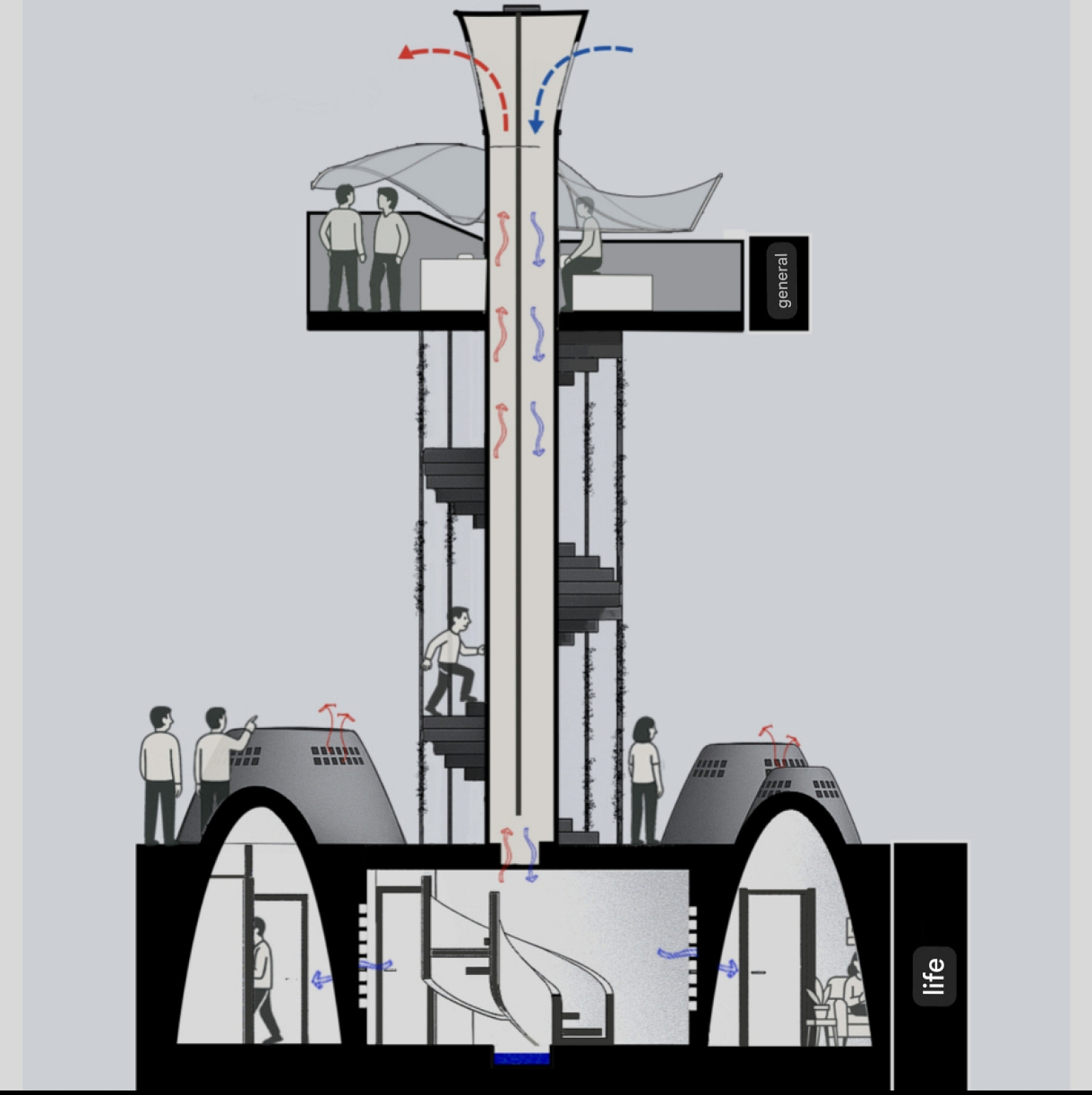
By placing a large portion of the building below ground level and using a domed form for the roof, the thermal exchange between the interior and exterior of the building is minimized. The soil layers act as a natural thermal insulation, and with the aid of vertical airflows, favorable thermal conditions are maintained within the interior spaces. In the domed roof, the middle layer contains hydrated salts (Hydrated Salt, as PCM) that store thermal energy and release it gradually throughout day and night, while the outer layer—a clay plaster—reflects sunlight, and the inner layer, made from natural materials, simultaneously provides insulation and aesthetic quality. This combination exemplifies sustainable architecture adapted to Yazd’s hot and arid climate.
In this design, a canopy is placed above the mahtabi (roofed courtyard) to reduce direct solar radiation, preventing excessive heating of the surface and the surrounding air. At the top of the windcatcher, photovoltaic panels are installed to supply electricity for the mahtabi spaces, supporting both the climatic performance and the energy sustainability of the building.
The canopy is made of PTFE fabric, which enhances the thermal and visual performance of the space through the following properties:
Reflects approximately 70–80% of solar radiation
High resistance to UV, dust, and temperature variations
Controlled transmission of natural light at low intensity, suitable for the mahtabi
Technical features include:
Flat drainage surface: A specially profiled frame creates a flush transition between the glass and the surrounding frame, providing a smooth path for rainwater drainage.
Low-emissivity glass (E-Low): Reduces radiant heat transfer, improving energy efficiency.
Thermally optimized PVC frame: The surrounding frame is designed to reduce heat transfer and enhance insulation.
Sealing: A dual-layer sealing system minimizes water and air infiltration.
Composite thermal insulation base reinforced with glass layers: Enhances strength and reduces heat transfer.
Sensors and automation:
Wind and rain sensors: Automatically open or close the skylight under varying weather conditions, either individually or in groups.
Contactless magnetic sensor: A switch embedded in the frame reports the skylight’s open or closed status without contact.
In Yazd’s climate, prevailing winds blow from the northwest and west, with speeds ranging between 10 and 18 m/s during many months, enabling efficient natural ventilation. Relative humidity is often below 30%, and summer temperatures exceed 38°C, emphasizing the need for climatic design strategies. The central windcatcher channels the prevailing winds into the interior spaces and exhausts air through upper openings, creating continuous vertical ventilation and a steady supply of fresh air. This process improves indoor air quality while reducing mechanical energy consumption.
By placing a water basin at the base of the windcatcher, the passing air is cooled and humidified. Combined with the upward airflow, this provides a naturally comfortable thermal environment.

Copyright © 2026 INSPIRELI | All rights reserved. Use of this website signifies your agreement to the Terms of Use, Privacy Policy, and use of cookies.
